




In an increasingly interconnected world, events unfolding thousands of miles away
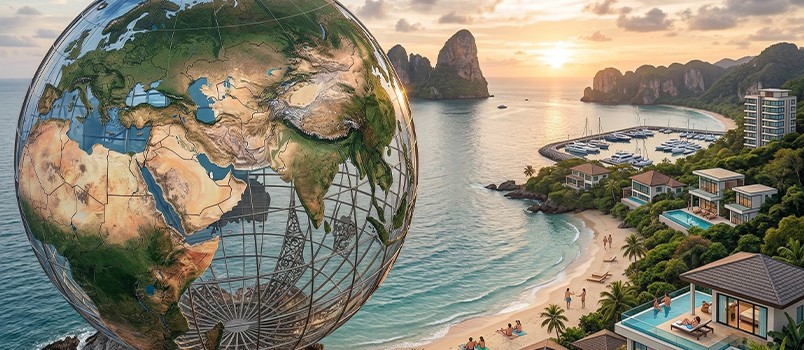
In an increasingly interconnected world, events unfolding thousands of miles away can ripple through economies, industries and travel patterns with surprising speed. Recent tensions in the Middle East have once again reminded us how global stability can shift quickly, affecting aviation routes, energy markets and international mobility. For destinations like Phuket, which depend heavily on global travel, such developments inevitably raise an important question: could prolonged geopolitical instability reshape tourism flows to Thailand?
At first glance the answer might seem obvious. Airspace closures, changing flight paths and rising fuel prices inevitably create challenges for international travel. Several airlines have already been forced to reroute flights or suspend services across parts of the Middle East following the current conflict, as regional airspace closures have disrupted normal aviation routes.
Yet history shows that global tourism rarely stops altogether. It adapts.
The Aviation Ripple Effect
Much of the world’s long-haul aviation network relies on the Middle East as a key transit hub. Cities such as Doha, Dubai and Abu Dhabi have become global connectors linking Europe, Asia and Africa. When conflict affects this region, airlines must reroute aircraft, often adding flight time and increasing fuel consumption.
At the same time, energy markets can react quickly. The Strait of Hormuz, one of the world’s most important maritime chokepoints, handles roughly 20% of global oil and liquefied natural gas shipments.
Any disruption to this route can push oil and jet fuel prices higher, affecting airline operating costs and potentially ticket prices. Recent market movements have already shown how sensitive aviation fuel is to geopolitical instability.
For destinations dependent on long-haul travel, this creates short-term uncertainty. However, the relationship between global events and tourism demand is rarely straightforward.
Thailand’s Quiet Resilience
Thailand has experienced decades of global disruptions: financial crises, political instability, pandemics, natural disasters and geopolitical tensions. Yet one remarkable pattern consistently emerges: tourism here tends to recover faster than many expect.
Researchers studying Thailand’s tourism sector often point to the country’s strong 'destination resilience', supported by both government planning and the adaptability of the private sector.
Part of this resilience stems from diversity. Thailand welcomes visitors from across Europe, Asia, Australia, the Middle East and North America. When one market slows, another often fills the gap.
But another factor is more subtle.
Thailand has long been perceived internationally as a place of refuge, relaxation and personal reinvention.
For many visitors, the country represents something increasingly rare in a complicated world: a place where life feels simpler, calmer and safer.
Tourism and Property: Two Sides of the Same Coin
In Phuket especially, tourism and property markets have always moved together.
Visitors who first arrive on holiday often become repeat visitors. Over time some decide to spend part of the year here. Eventually many look for property, whether a condominium overlooking the sea, a private villa, or simply a long-term lifestyle base.
Phuket itself is a good example of how tourism can transform an economy. Once known primarily for tin mining, the island has evolved into one of Asia’s most recognised resort destinations over the past four decades.
As tourism grew, so did infrastructure, international schools, healthcare facilities, marinas and residential developments. Today the island attracts not only holidaymakers but entrepreneurs, retirees and digital professionals seeking a better quality of life.
In other words, tourism does not simply fill hotels. It often plants the seed for long-term residency and investment.
Energy Security and Thailand’s Response
Of course, global conflicts do have economic implications.
Energy markets are often among the first to react to geopolitical tensions, influencing airline routes, shipping costs and national economies. Thailand, like many Asian countries, imports a significant portion of its energy needs.
The Strait of Hormuz, one of the world’s most critical maritime chokepoints, carries a significant share of global oil and liquefied natural gas shipments. Any disruption to this route can quickly influence global energy prices and airline operating costs. Like many nations, Thailand relies on imported energy, but the country maintains strategic reserves and diversified supply arrangements designed to provide stability and flexibility should global supply routes face disruption.
In practice, this means that while energy markets may fluctuate in the short term, Thailand is not uniquely vulnerable.
Global supply chains adjust quickly when necessary.
A World Still Drawn to Safe Places
Perhaps the most interesting question is not whether global events will affect tourism, because they always do, but how travellers respond to uncertainty.
Historically, when the world becomes more unpredictable, people tend to seek destinations that feel stable, welcoming and familiar.
Thailand has long benefited from this perception.
The country offers a rare combination: political neutrality in most global conflicts, a culture of hospitality, relatively open visa policies, and a cost of living that allows many foreigners to enjoy a comfortable lifestyle.
In recent years Thailand has also expanded visa programmes designed to attract long-stay visitors, retirees, remote professionals and investors.
For many people seeking a different pace of life, that combination is powerful.
The Larger Question
Conflicts inevitably raise deeper questions.
Why do nations continue to drift toward confrontation when the economic and human costs are so obvious?
History suggests that wars are rarely simple. They emerge from complex geopolitical tensions, strategic interests and political calculations. Yet for ordinary people watching events unfold from afar, the logic often seems difficult to understand.
What is clearer, however, is that despite these cycles of instability, human mobility rarely stops. People still travel. They still search for opportunity. They still seek places where life feels calmer and more meaningful.
And in that search, destinations like Thailand continue to stand out.
Phuket’s Enduring Appeal
In an increasingly unpredictable world, people naturally look for places where life feels stable, welcoming and safe. Thailand has long played that role for travellers, retirees and entrepreneurs alike.
If recent global events remind us of anything, it is that the world remains interconnected in ways both fragile and remarkable. Conflicts can reshape flight paths, influence energy markets and temporarily disrupt global travel, but the deeper motivations behind tourism rarely change. People still seek beauty, warmth, opportunity and peace of mind.
For many, Phuket represents all of these things at once.
While geopolitics continues to shape the world in complex and sometimes troubling ways, destinations that offer calm, hospitality and a sense of normality often become even more valuable.
And that may be why, despite decades of global uncertainty, Thailand’s appeal has endured, and why islands like Phuket continue to attract those searching for a better way of living.
by Thai Residential Phuket Property Guide
This article is from the Thai Residential Phuket Property Guide. To download the 2025/2026 Guide visit ThaiResidential.com

Contact info:
Thai Residential
82/37 Sam Pao Courtyard
Moo 4, Patak Road
T.Rawai, Phuket 83130
+66 94 8411 918
[email protected]
www.thairesidential.com
Contact info:
Thai Residential
82/37 Sam Pao Courtyard
Moo 4, Patak Road
T.Rawai, Phuket 83130
+66 94 8411 918
[email protected]
www.thairesidential.com





Visit our other website











 GO TO TOP